

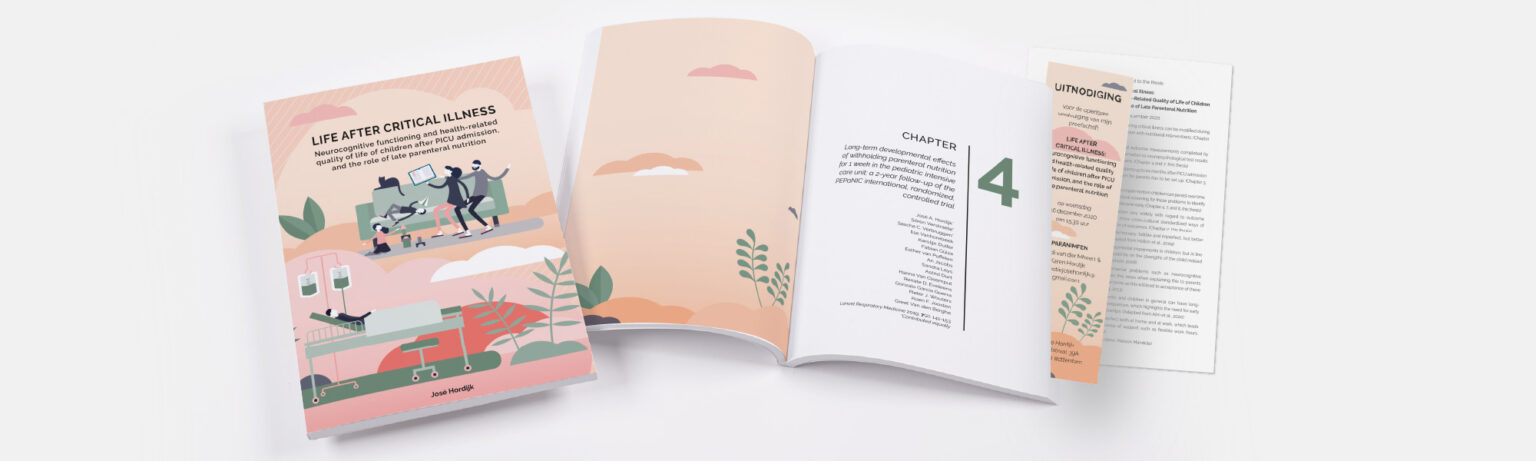
Why is a proof copy of my thesis being produced?
Once your designer has finished laying out your thesis – including all the chapters and the cover – you’ll receive it by email. This is a preview of what the final result will look like. However, we realise that it can be difficult to judge this on a screen. In this article, we explain why a proof is produced for a thesis. Curious to know how a designer initially formats your thesis? Read our article on the layout of your thesis.
From PDF to proof
Before a proof is produced, you will first receive a PDF of the entire thesis, including both the chapters and the cover. The designer will let you know if any sections are still missing at that stage. You may, for example, need to submit the acknowledgements or your CV a little later. This is therefore the time to submit these files so that, ultimately, a complete thesis ends up on the shelf.
We recommend that you submit the PDF below to the printer as soon as possible for a proof. A proof allows you to assess the print quality. You will already have assessed and approved the design at this stage, earlier in the layout process. Would you like to read more about this? You can do so in the article: How do you determine the design of your dissertation?
Files for the printer
The designer will take care of submitting the files to the printer for you – it’s that simple. So all you need to do is let us know that you’d like a proof to be produced, and the rest will take care of itself. Well, almost: you’ll still need to let the printer know your preferred printing specifications. Think of the type of paper, for example. If you don’t have a printer yet, we can help you with that – just application to have your thesis printed on our website.
You will receive a proof at an address of your choice. This can be your home address, or your university. The proof will always be printed on the paper and to the standard you have chosen.
Changes based on the proof
When you receive the proof and start going through it, pay particular attention to the quality of the print. So take a look at the images: are the colours and resolution as you expected? Is the text clearly legible? Does the paper feel as you expected? If you have any doubts, you can always contact the printer to discuss them.
Of course, you may also spot some layout corrections now that everything has been printed. With a printed thesis, different issues often stand out compared to when you view it on a screen. You can, of course, pass on any corrections to your personal designer. As with earlier stages of the layout process, you should submit corrections based on the proof in a PDF file, which you then send to the designer. In a separate article, we’ll discuss how to easily mark up corrections in Acrobat Reader.

Once the proof has been checked and any final corrections made, a thesis is ready to go to press. This is, of course, an exciting moment. But if you’ve started off well prepared and worked closely with your designer, the result is sure to be just as good as you’d hoped. You can find more information on our website about the formatting of your thesis. It often takes two weeks for all theses to be printed and delivered. After that, it’s up to you – the defence is the grand finale of a wonderful period.